


Stainless steel is one of the most widely used materials in construction, manufacturing, food processing, marine engineering, and industrial applications. Among all stainless steel grades, 304 stainless steel and 316 stainless steel are the two most popular choices worldwide.
But what is the difference between 304 and 316 stainless steel? Which one is better for your project? And how do you choose the right stainless steel sheet, coil, or pipe?
In this guide, we will explain the key differences, applications, advantages, and price factors of 304 and 316 stainless steel to help buyers, contractors, and distributors make the right decision.
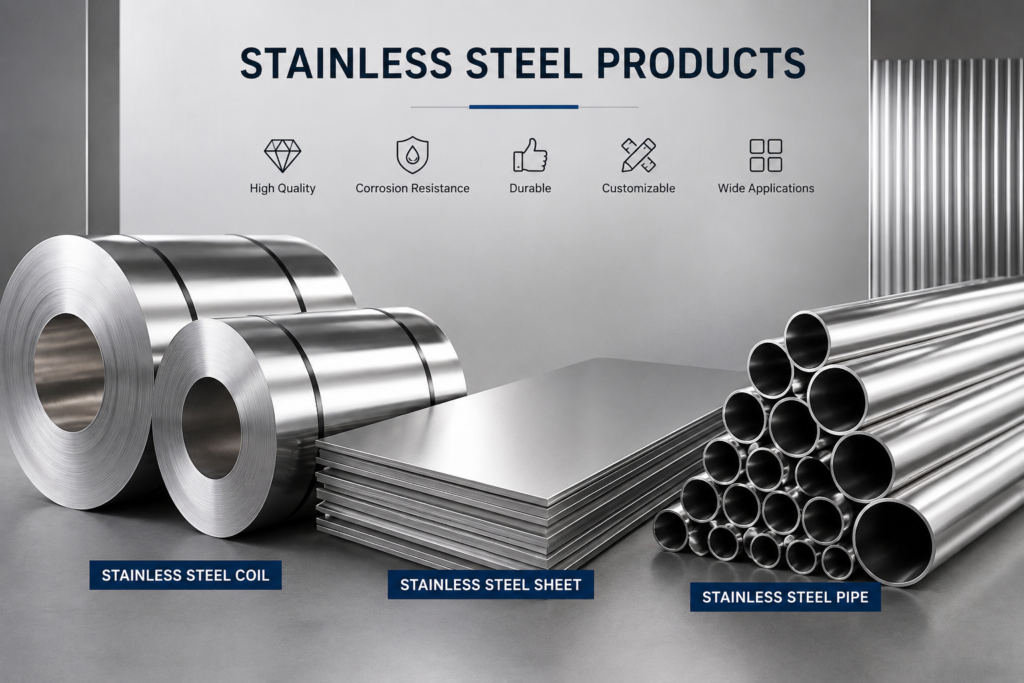
What Is 304 Stainless Steel?
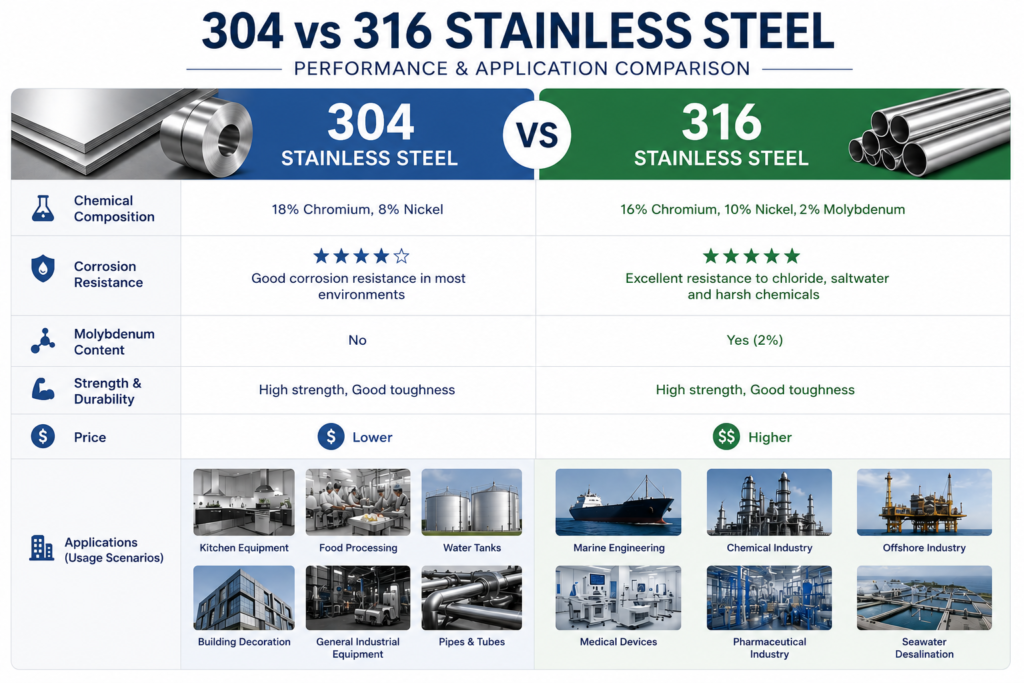
304 stainless steel is the most commonly used stainless steel grade. It belongs to the austenitic stainless steel family and contains:
- 18% chromium
- 8% nickel
Because of its excellent corrosion resistance, durability, and affordability, 304 stainless steel is widely used in:
- Kitchen equipment
- Food processing machinery
- Architectural decoration
- Water tanks
- Industrial equipment
- Stainless steel sheets and coils
- Welded pipes and tubes
304 stainless steel offers good performance in most indoor and outdoor environments.
What Is 316 Stainless Steel?
316 stainless steel is an upgraded version of 304 stainless steel. It contains:
- 16% chromium
- 10% nickel
- 2% molybdenum
The added molybdenum significantly improves corrosion resistance, especially in:
- Marine environments
- Chemical industries
- Coastal areas
- Acidic environments
- Saltwater applications
316 stainless steel is commonly used for:
- Marine equipment
- Chemical tanks
- Pharmaceutical machinery
- Medical devices
- Offshore construction
- High-end industrial piping systems
304 vs 316 Stainless Steel: Key Differences
| Property | 304 Stainless Steel | 316 Stainless Steel |
|---|---|---|
| Corrosion Resistance | Good | Excellent |
| Molybdenum Content | No | Yes (2%) |
| Saltwater Resistance | Moderate | Excellent |
| Price | Lower | Higher |
| Common Applications | General industry | Marine & chemical industry |
| Weldability | Excellent | Excellent |
| Heat Resistance | Good | Better |
The biggest difference is corrosion resistance. If your project is exposed to saltwater or chemicals, 316 stainless steel is usually the better choice.
Corrosion Resistance Comparison
304 Stainless Steel
304 stainless steel performs well in normal environments, including:
- Indoor applications
- Dry climates
- Freshwater systems
- Food-grade applications
However, in high-salt or acidic environments, it may develop corrosion over time.
316 Stainless Steel
316 stainless steel provides superior resistance against:
- Chlorides
- Saltwater
- Industrial chemicals
- Coastal humidity
This is why 316 stainless steel is often called “marine-grade stainless steel.”
Price Difference Between 304 and 316 Stainless Steel
One of the most important factors for buyers is price.
316 stainless steel is generally more expensive because it contains more nickel and molybdenum. Depending on market conditions, the price difference is usually between 15% and 30%.
If your application does not require extreme corrosion resistance, 304 stainless steel is often the more cost-effective solution.
For highly corrosive environments, investing in 316 stainless steel can reduce maintenance costs and extend service life.
Applications of 304 Stainless Steel
304 stainless steel sheets, coils, and pipes are widely used in:
Construction Industry
- Decorative panels
- Elevator sheets
- Handrails
- Roofing systems
Food Processing
- Kitchen sinks
- Food equipment
- Storage tanks
Industrial Manufacturing
- Steel pipes
- Machinery parts
- Automotive components
Household Products
- Cookware
- Appliances
- Furniture
Applications of 316 Stainless Steel
316 stainless steel is preferred for demanding environments such as:
Marine Engineering
- Shipbuilding
- Offshore platforms
- Coastal construction
Chemical Industry
- Chemical tanks
- Pipelines
- Industrial reactors
Medical Equipment
- Surgical instruments
- Pharmaceutical systems
Water Treatment
- Desalination equipment
- Water purification systems
Stainless Steel Sheet, Coil, and Pipe Options
Professional stainless steel suppliers usually provide:
Stainless Steel Sheets
Available finishes:
- 2B
- BA
- No.4
- Hairline
- Mirror finish
Common thickness:
- 0.3mm – 100mm
Stainless Steel Coils
Features:
- High strength
- Easy processing
- Custom width available
Stainless Steel Pipes
Types:
- Seamless stainless steel pipe
- Welded stainless steel pipe
Common applications:
- Fluid transportation
- Structural engineering
- Industrial systems
How to Choose Between 304 and 316 Stainless Steel
Choose 304 stainless steel if:
- Your project is indoors
- Budget is important
- Environment is not highly corrosive
- You need general industrial use
Choose 316 stainless steel if:
- Your project is near the ocean
- It involves chemicals or saltwater
- Long-term corrosion resistance is critical
- You need premium industrial performance
Why Buy Stainless Steel From China?
China has become one of the world’s largest stainless steel manufacturing centers.
Professional Chinese stainless steel suppliers can provide:
- Competitive prices
- Large inventory
- Custom sizes
- OEM processing
- Fast delivery
- Export packaging
- Global shipping support
Many international buyers source stainless steel sheets, coils, and pipes from China for construction, industrial, and infrastructure projects.
How to Choose a Reliable Stainless Steel Supplier
When selecting a stainless steel supplier, buyers should consider:
Product Quality
Check whether the supplier can provide:
- Mill test certificates (MTC)
- ISO certification
- SGS inspection
Production Capability
A reliable factory should support:
- Custom dimensions
- Surface processing
- Cutting and welding services
Export Experience
Experienced exporters can help with:
- Container loading
- International shipping
- Documentation support
FAQ About 304 and 316 Stainless Steel
Is 316 stainless steel better than 304?
316 stainless steel has better corrosion resistance, especially in marine and chemical environments. However, 304 stainless steel is more cost-effective for general applications.
Can 304 stainless steel rust?
304 stainless steel has strong corrosion resistance, but it can rust under extreme saltwater or chemical exposure.
Which stainless steel is food grade?
Both 304 and 316 stainless steel are commonly used in food-grade applications.
Is 316 stainless steel worth the extra cost?
If your environment is corrosive or near saltwater, 316 stainless steel is usually worth the additional cost due to its longer service life.
Conclusion
Both 304 and 316 stainless steel are excellent materials for industrial and construction applications.
- 304 stainless steel is economical, versatile, and widely used.
- 316 stainless steel offers superior corrosion resistance for harsh environments.
The best choice depends on your project requirements, budget, and operating environment.
If you are looking for a reliable stainless steel sheet, coil, or pipe supplier, working with an experienced manufacturer can help ensure stable quality, competitive pricing, and long-term project success.
