

Introduction
Choosing the right pipe material is critical for both performance and longevity in industrial and commercial applications. Stainless steel pipes and carbon steel pipes each offer unique advantages depending on the operational environment, transported substances, and project requirements. Understanding their material properties, durability, and cost considerations ensures the right decision for every application.
Composition and Material Properties
Alloy Composition Differences
Stainless steel pipes contain key alloying elements like chromium, nickel, and copper, with chromium content typically above 10.5–12.5%, forming a protective passivation layer. This enhances corrosion resistance and heat tolerance. Carbon steel pipes, commonly Q195 or Q235, primarily consist of iron and carbon, with trace amounts of silicon, manganese, sulfur, and phosphorus, offering strength and affordability but limited corrosion protection.
Mechanical Properties
Stainless steel provides superior tensile strength, hardness, and fatigue resistance, making it suitable for high-pressure, cyclic load, and harsh environments. Carbon steel delivers adequate durability for structural applications but is more prone to fatigue under repeated stress.
Physical Characteristics
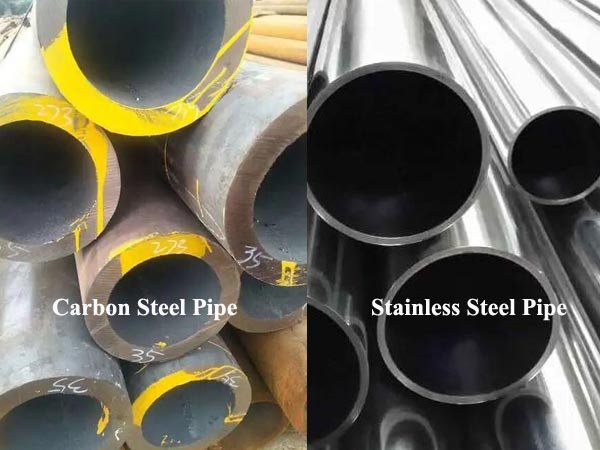
- Appearance: Stainless steel is lustrous and reflective; carbon steel has a matte, darker finish.
- Weight and Density: Stainless steel density ranges 7.75–8.1 g/cm³, slightly heavier than carbon steel (7.85–7.88 g/cm³), influencing handling and structural design.
- Impact: Higher density of stainless steel enhances strength but increases installation considerations.
Corrosion Resistance and Longevity
Oxidation Resistance
Stainless steel forms a chromium oxide passivation layer, providing superior resistance to rust and chemical degradation. Carbon steel lacks this protective layer, making it susceptible to corrosion, especially in moisture or chemically aggressive environments.
Environmental Factors
Stainless steel performs reliably across a broad range of conditions, including acids, chlorides, and high humidity. Carbon steel requires protective coatings to extend service life.
Maintenance Requirements
Stainless steel demands minimal maintenance, whereas carbon steel requires regular inspections and surface treatments to prevent rust, directly affecting lifecycle costs.
Strength, Durability, and Mechanical Performance
Fatigue Resistance and Load-Bearing Capacity
Stainless steel maintains structural integrity under cyclic loads and vibration, while carbon steel is suitable for static or less demanding conditions.
Thermal Conductivity and Expansion
Carbon steel exhibits higher thermal conductivity, ideal for heat transfer applications. Stainless steel has greater thermal expansion, which must be considered in temperature-sensitive designs.
Material Density Impact
Weight differences influence handling, transportation, and structural load calculations, critical in engineering and industrial projects.
Cost and Economic Considerations
Material Cost Comparison
Stainless steel is more expensive upfront due to alloying elements and fabrication requirements. Carbon steel is cost-effective, making it attractive for large-scale projects.
Fabrication, Welding, and Installation Expenses
Stainless steel requires specialized welding (TIG) and precise fabrication. Carbon steel can be welded using simpler methods (MIG), reducing labor costs.
Lifecycle Cost and ROI
While stainless steel has a higher initial cost, its long-term durability and reduced maintenance can provide superior ROI. Carbon steel may incur higher maintenance and replacement expenses over time.
Welding, Fabrication, and Handling
- TIG vs MIG Welding: Stainless steel needs TIG to avoid contamination; carbon steel can use MIG or stick welding.
- Preheating & Post-Weld Treatments: Carbon steel may require preheating; stainless steel requires post-weld passivation.
- Fabrication & Work Hardening: Stainless steel’s work-hardening rate demands precise handling; carbon steel is more forgiving in fabrication.
Applications Across Industries
Stainless Steel Pipes:
- Chemical processing
- Pharmaceutical manufacturing
- Food and beverage pipelines
- Oil & gas and marine environments
Carbon Steel Pipes:
- Construction and structural pipelines
- Water and gas distribution
- Automotive exhaust systems
- Shipbuilding and general industrial uses
Standards and Specifications
- ASTM, API, ISO: Widely adopted standards for pipe manufacturing
- Seamless vs Welded: Stainless steel seamless and welded options; carbon steel welded and seamless
- Special-Shaped Pipes: Round, square, rectangular, hexagonal, and other customized geometries
Factors to Consider When Choosing Pipes
- Transported Substance: Corrosive liquids require stainless steel
- Temperature & Pressure: Carbon steel suits high-heat, low-corrosion environments; stainless steel handles chemical exposure
- Cost & Maintenance Budget: Balance initial investment with long-term expenses
- Aesthetic Requirements: Stainless steel offers a polished, corrosion-resistant finish for visible installations
Environmental Impact and Sustainability
- Recyclability: Stainless steel is highly recyclable (~90%)
- Energy Consumption: Carbon steel generally requires less energy to produce
- Lifecycle Considerations: Material choice impacts long-term ecological footprint
Frequently Asked Questions (FAQ)
Q: What are the aesthetic differences?
A: Stainless steel is reflective and bright; carbon steel is matte and dark.
Q: How do magnetic properties differ?
A: Carbon steel is more magnetically responsive; stainless steel (austenitic) is largely non-magnetic.
Q: Performance in extreme weather?
A: Stainless steel resists corrosion and thermal fatigue; carbon steel can corrode and expand variably.
Q: Sound/acoustic differences?
A: Stainless steel absorbs sound better due to higher density; carbon steel may transmit sound more readily.
Q: Maintenance considerations?
A: Stainless steel requires minimal upkeep; carbon steel needs regular inspections and coatings.
Conclusion
Stainless steel and carbon steel pipes serve distinct purposes across industries. Stainless steel excels in corrosion resistance, durability, and hygiene-critical applications, while carbon steel is cost-effective and strong for structural projects. Selecting the right material depends on environmental conditions, transported substances, and long-term economic considerations.
About Hanhuang Steel
Hanhuang Steel supplies high-quality stainless steel pipe and carbon steel pipes suitable for industrial, commercial, and structural projects. Contact us for quotes or technical consultation to ensure your pipeline system is engineered for longevity and reliability.